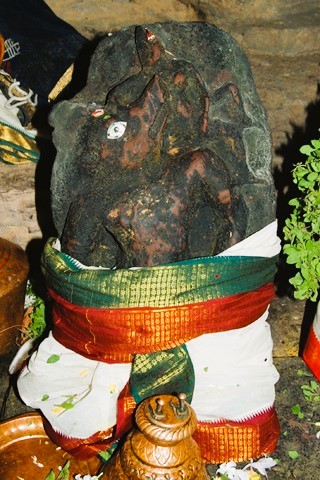
The Sanctum Idol
Boar-faced, lion-tailed form, shown with Bhudevi
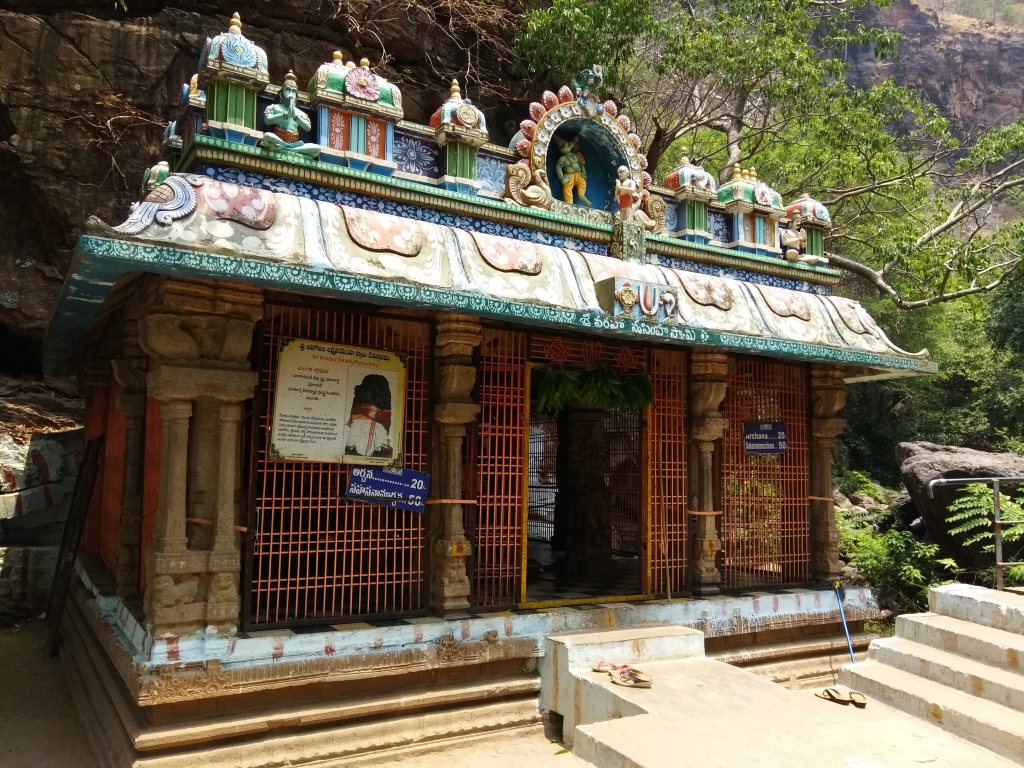
The Temple View
Set beside the Varaha Theertham on the Upper Ahobilam trail
A remarkable combined form — boar-faced, lion-tailed, and human in body — Kroda Narasimha recalls the moment the Lord dove into the netherworld to recover the sacred Vedas and the earth goddess Bhudevi.
Kroda Narasimha is one of the most distinctive of the nine forms — depicted with the head of a boar (Varaha), the tail of a lion, and a human torso, standing in a graceful tribhanga posture. The shrine is also known by devotees as Varaha Narasimha, and the site itself is called Siddha Kshetra.
The cave sanctum houses two deities side by side — a seated Lakshmi-Narasimha, and the standing Kroda (Varaha) Narasimha shown with the earth goddess Bhudevi resting near his tusks, echoing the Varaha avatar's earlier rescue of the earth from the cosmic ocean.
Kroda Narasimha's story picks up immediately after the slaying of Hiranyakashipu, when the Lord's fury turned toward an unexpected figure — Brahma himself.
Having slain Hiranyakashipu, Narasimha remained furious at Brahma, who had granted the demon king the very boon that made him nearly invincible.
Summoned before the still-raging Lord, Brahma trembled in fear — and in that moment, the sacred Vedas slipped from his hands.
The earth goddess Bhudevi caught the falling Vedas and carried them down to Patala, the netherworld, to protect them from harm.
At the request of the Devas, the Lord assumed the Kroda (boar) form and descended into the netherworld himself to recover both the Vedas and Bhudevi.
Narasimha emerged successful, and once his anger finally settled, Brahma asked for the Vedas back — but the Lord chose instead to entrust them to Goddess Lakshmi, a moment tradition connects to the origin of the neighboring Malola Narasimha shrine.
Kroda Narasimha is often read as a symbolic bridge between two of Vishnu's ten avatars — Varaha, the boar who once rescued the earth from the cosmic ocean, and Narasimha, who protected his devotee Prahlada. By combining both forms in a single deity, the shrine represents an unbroken continuity of divine protection across different ages and different threats.
A short climb from here brings you to the gentle Malola Narasimha, or head back to the main Ahobila shrine.